The Short Answer
All three dissolve gold in a cyanide solution. The difference is where the leaching happens and when the carbon meets the pulp.
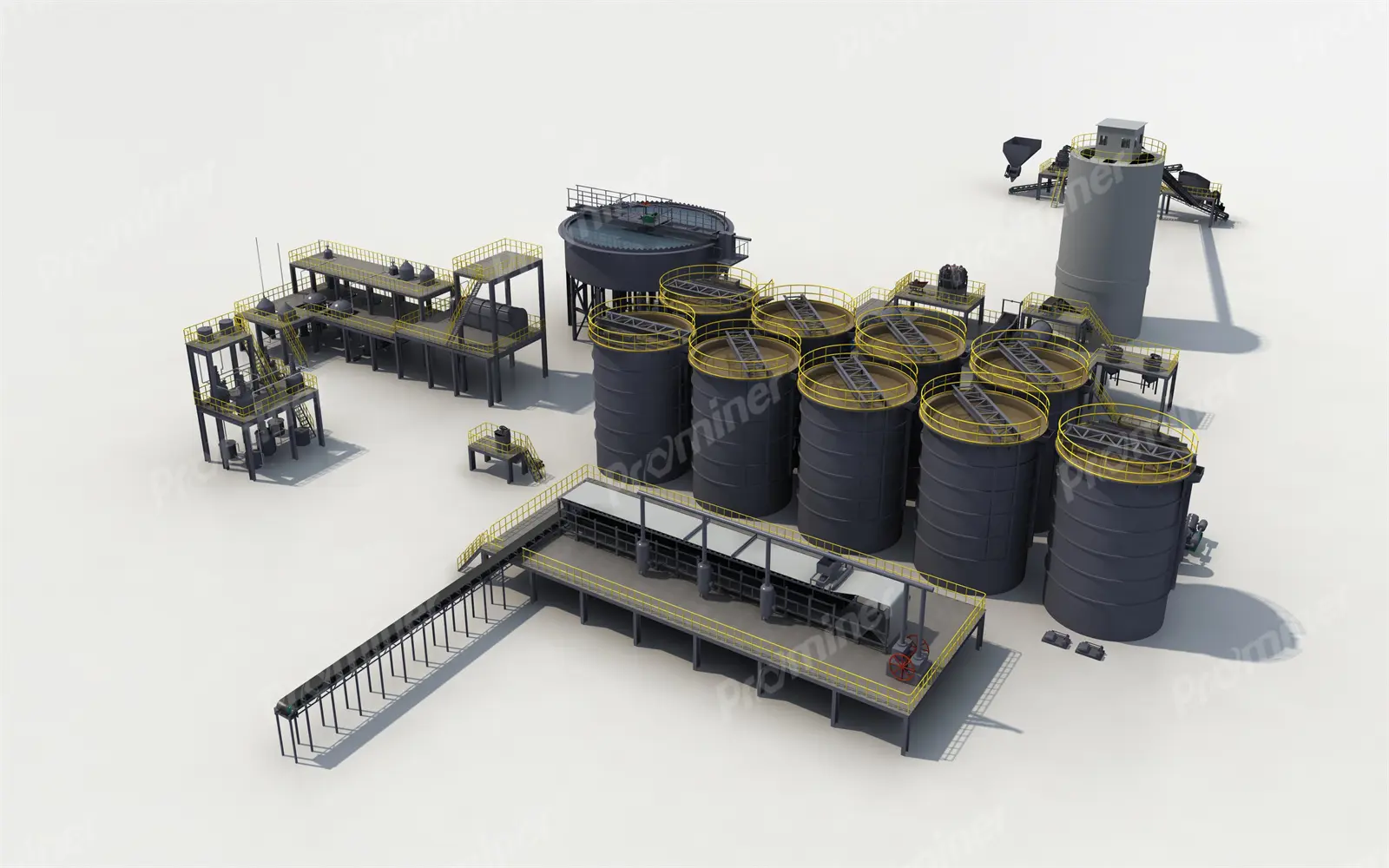
- CIL, Carbon in Leach. Leaching and carbon adsorption happen at the same time in the same tanks. Fewer tanks, lower capital, and the carbon is present to catch gold the moment it dissolves
- CIP, Carbon in Pulp. The ore is leached to completion first, then the pulp moves to a separate train of tanks where carbon adsorbs the gold. More tanks, cleaner control of each step
- Heap leach. Crushed ore is stacked on a lined pad and solution is trickled through it over weeks or months. No tanks, no grinding, far lower capital, materially lower recovery
For most small and medium Tanzanian hard-rock operations, CIL is the default. CIP earns its extra tanks on higher-grade ore where carbon management matters. Heap leach only makes sense on large tonnages of low-grade ore that will not pay for grinding.
Side by Side
Recovery
CIL and CIP both reach 88 to 95 percent on free-milling ore, and the gap between them is small enough that recovery alone rarely decides the choice. Heap leach typically returns 60 to 80 percent because the ore is only crushed rather than ground, so a proportion of the gold is never liberated and solution never reaches it. On a high-grade orebody that difference is decisive. On a very low-grade one, recovering 70 percent cheaply beats recovering 92 percent at a cost the ore cannot carry.
Capital cost
Heap leach is by far the cheapest to build, because it avoids the grinding circuit, the tank train, the agitators and much of the water infrastructure. CIL is next, using fewer tanks than CIP for the same duty. CIP is the most tank-intensive of the three. Against that, heap leach needs a properly engineered and lined pad, and pad construction is a real capital item that is often underestimated.
Time to gold
CIL and CIP produce gold within a day or two of ore entering the plant, with total residence time of 18 to 36 hours across the tank train. Heap leach takes weeks to months per lift, and the leach curve flattens slowly, so cash is tied up in ore on the pad for a long time. For an operation that needs revenue quickly, that working capital difference matters more than the recovery difference.
Footprint and water
Tank plants are compact and recycle water through a thickener. Heap leach spreads over a large area and needs a solution pond system, which brings both land and containment obligations. In water-constrained districts the tank plant with a functioning recycle circuit is usually the more practical answer.
Preg-robbing ore
This is where CIL earns its place decisively. Some ore contains carbonaceous material that adsorbs dissolved gold from the solution, stealing it before it can be recovered. Because CIL has activated carbon in the tank competing for that gold from the moment it dissolves, it counters preg-robbing in a way that CIP, which leaches first and adsorbs later, cannot. If diagnostic test work shows preg-robbing behaviour, CIL is not a preference, it is the requirement.
How to Choose
- Choose CIL if you are a small to medium hard-rock operation with free-milling ore, if capital is constrained, or if the ore shows any preg-robbing tendency. This covers the large majority of Tanzanian gold projects
- Choose CIP if grade is high enough that carbon inventory and elution scheduling justify separating the two steps, and if you want cleaner control and measurement of leach kinetics independently of adsorption
- Choose heap leach if tonnage is large, grade is low, the ore leaches acceptably at a coarse crush, and you have the land and the containment engineering for a lined pad. Confirm all of that with column leach test work before committing
What All Three Share
Every one of these routes uses cyanide, and that brings the same set of obligations regardless of which you pick: permitting, secure storage, containment, pH control above 10.5 to suppress hydrogen cyanide gas, monitoring, trained operators, and an emergency response plan. Many operators additionally align with the International Cyanide Management Code. Budget for this properly. It is not an add-on to the plant, it is part of the plant.
Common Mistakes
- Choosing on capital cost alone. The cheapest circuit that recovers 20 percent less gold is rarely the cheaper option over the life of the orebody
- Skipping diagnostic leach test work. Refractory or preg-robbing ore discovered after commissioning is the most expensive surprise in gold processing
- Grinding too coarse to save power. Recovery falls faster than the power bill does
- Underestimating the pad on heap leach. Liner, drainage, ponds and containment are a significant engineering project in themselves
- Treating cyanide compliance as paperwork. It is the highest-hazard part of the operation and the one most likely to close it
Regions We Serve
Frequently Asked Questions
Which is cheaper to build, CIL or CIP?
CIL, in almost all cases, because leaching and adsorption share the same tanks so fewer tanks and agitators are needed for the same residence time. The saving is meaningful at small scale, where tank count is a large share of plant cost.
Can I convert a CIP plant to CIL later?
Often yes, since the tanks and agitators already exist and the change is largely about where carbon is introduced and how interstage screening is arranged. Conversion in the other direction, CIL to CIP, is harder because you need additional tanks. If there is any doubt about the ore, building CIL keeps more options open.
Is heap leach viable in Tanzania?
It can be, on the right orebody, but the combination of high seasonal rainfall in parts of the country, land access, and containment engineering makes it a more demanding proposition than in arid jurisdictions. Column leach test work and a serious look at the water balance should come before any commitment.
What recovery should I expect from CIL on Lake Victoria Goldfields ore?
Free-milling banded iron formation hosted and shear-zone hosted gold from the Lake Victoria Goldfields commonly returns 88 to 95 percent through a well-designed CIL circuit at an appropriate grind. Ore with significant sulphide association or carbonaceous material can fall well below that without pre-treatment, which is exactly what diagnostic test work is for.