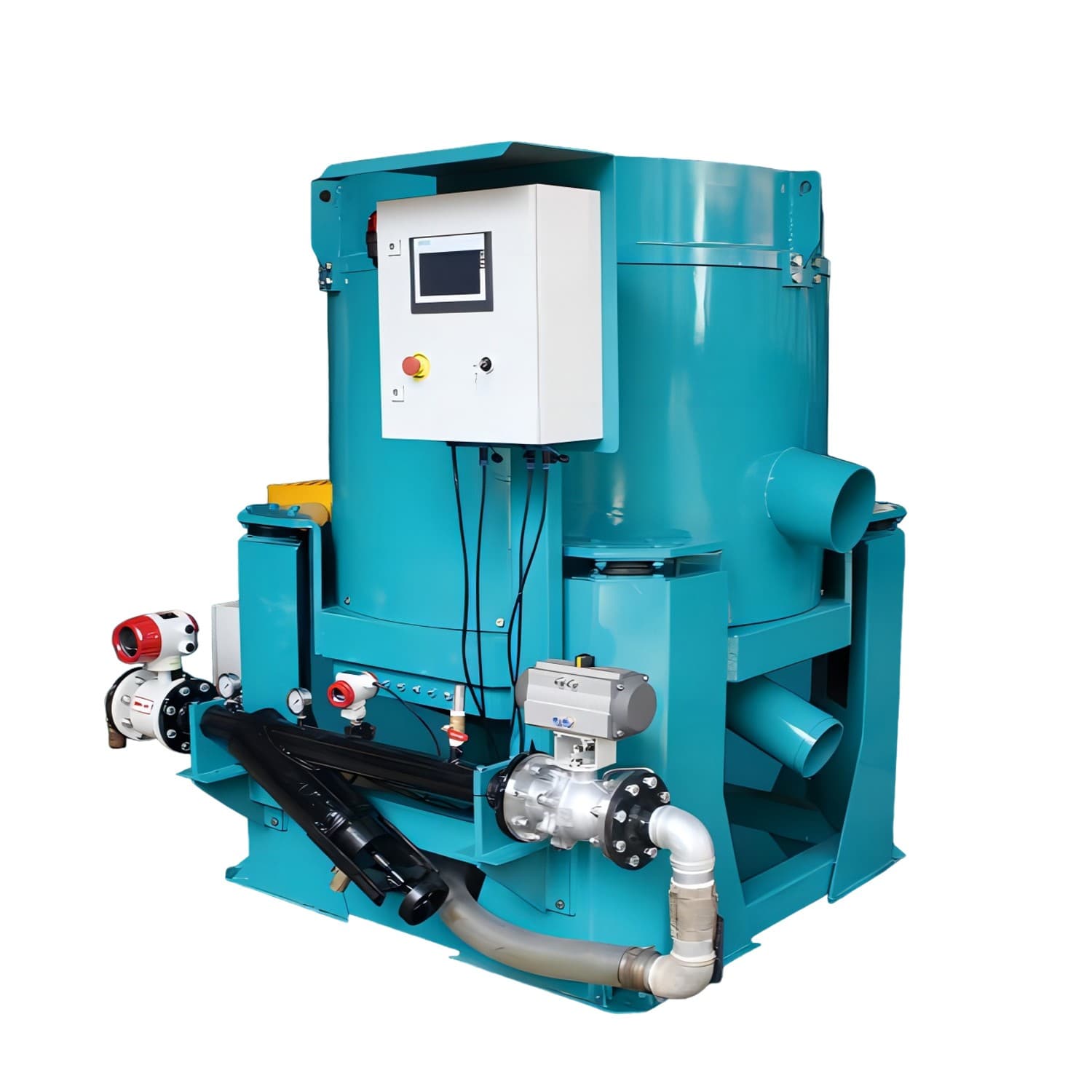
Centrifugal Gold Concentrator Specifications
The figures below describe typical industry specifications for this class of equipment rather than a single fixed model. Use them to scope a requirement, then confirm exact figures against the supplied unit before purchase.
| Specification | Typical value |
|---|---|
| Bowl sizes | 7.5", 12", 20", 30", 48" |
| Feed capacity | 0.5–100 t/h solids depending on bowl size |
| Maximum feed size | −2 mm typical, −6 mm on larger units |
| Recovery on liberated gold | 85–98% |
| Recoverable particle size | Down to ~20 µm |
| Centrifugal field | 60–200 G |
| Concentration ratio | 500:1 to 2,000:1 |
| Fluidisation water | 0.5–10 m³/h, clean and pressure-regulated |
| Drive power | 1.5–30 kW by size |
| Cycle type | Batch (timed) or continuous discharge |
| Reagents required | None, water only |
| Typical duty | Grinding-circuit scalping or standalone alluvial plant |
What a Centrifugal Gold Concentrator Is Used For
- Alluvial and eluvial gold recovery
- Hard-rock grinding circuit gravity scalping
- Tailings and mercury-amalgamation residue reprocessing
- Pilot plant and bulk-sample test work
- Mercury replacement in artisanal operations
Maintenance Schedule
Most premature failures in this equipment class trace back to a missed routine check rather than a design fault. The intervals below are a practical starting schedule; adjust them to your duty cycle and the manufacturer manual.
| Interval | Task |
|---|---|
| Every shift | Check fluidisation water pressure and flow; confirm no bowl vibration; inspect feed for oversize. |
| Weekly | Inspect bowl riffles and fluidisation holes for blockage; clean water manifold and strainer. |
| Monthly | Check drive belt tension and bearing temperature; inspect bowl liner wear. |
| Quarterly | Bowl removal and full inspection; balance check before refitting. |
| Annually | Replace bowl liner and fluidisation fittings; drive motor and gearbox service. |
Frequently Asked Questions
How much gold does a centrifugal concentrator recover?
On liberated free gold, 85–98%. Recovery falls sharply if gold is locked in sulphides or silicates, because the machine separates by density and cannot recover what is not liberated. Grind size therefore governs recovery more than machine settings do.
Can a centrifugal concentrator replace mercury?
Yes, and that is its most valuable application in Tanzania. It recovers a comparable or higher proportion of free gold with no mercury at all, eliminating both the health exposure and the mercury losses that amalgamation incurs. Capital cost is repaid quickly where gold prices and throughput are reasonable.
What feed size does a centrifugal concentrator need?
Generally minus 2 mm, with larger bowls tolerating up to 6 mm. Oversize plugs the fluidisation holes and blinds the riffles. A screen ahead of the concentrator is not optional. It is what keeps the unit working.
How much water does it need?
0.5–10 m³/h of clean fluidisation water depending on bowl size, at regulated pressure. Water quality matters: silt-laden water blocks the fluidisation holes and quietly destroys recovery over a few shifts. Many recovery complaints on site trace back to water, not the machine.
Batch or continuous discharge?
Batch units stop to flush concentrate and suit lower-grade, lower-throughput duty where interruption is acceptable. Continuous units discharge concentrate without stopping and suit higher grades or circuits that cannot pause. Batch is cheaper and simpler; continuous fits production plants.
Supply and Delivery Across Tanzania
Bart Mining supplies centrifugal gold concentrator and related equipment to mining operations throughout Tanzania, with primary coverage of the Lake Victoria Goldfields (Mwanza, Kahama, Geita, Shinyanga and Bukombe), alongside the Lupa Goldfields around Chunya and Mbeya, and delivery nationwide from Dar es Salaam.
Request a quotation
Need a centrifugal gold concentrator specified for your site?
Tell us your duty, depth or throughput and available power supply. We will come back with a specification and price, and flag anything on site that needs to change to make it work.