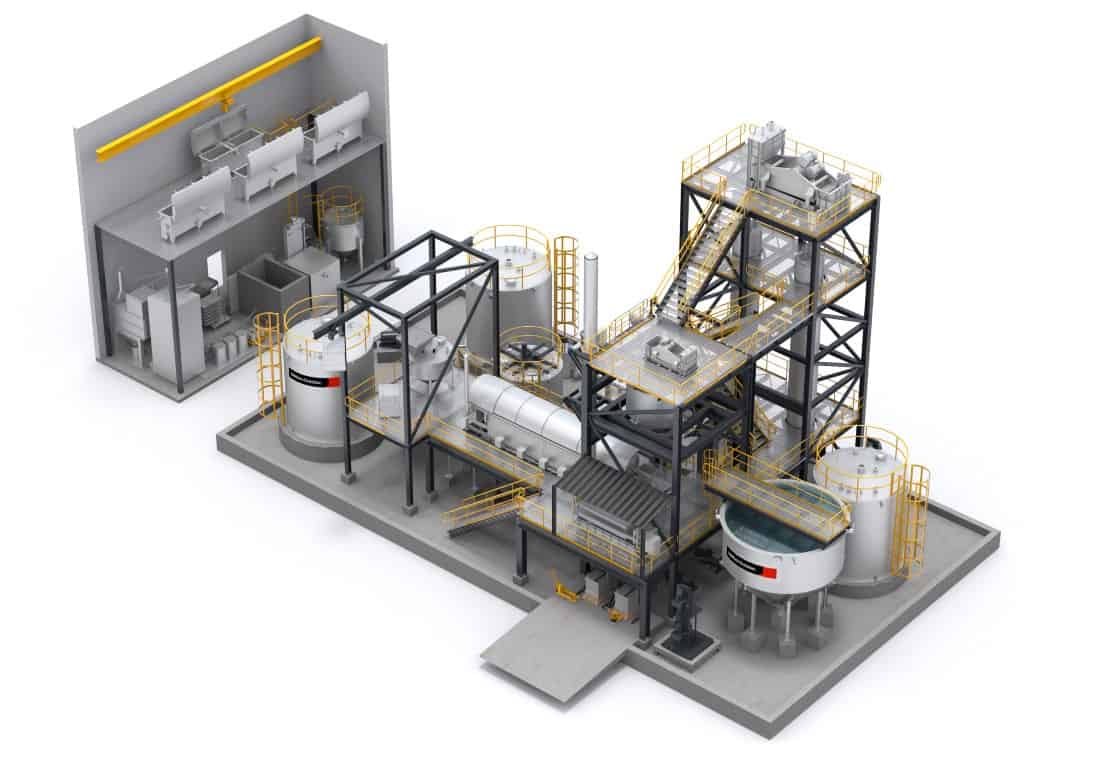
What You Are Actually Buying
An elution and electrowinning plant is the part of a gold circuit that turns loaded carbon into gold you can sell. Carbon from a CIL or CIP tank train, or from vat leaching, is stripped in a heated vessel with a hot caustic cyanide solution. The gold-rich solution then passes through an electrowinning cell, where gold plates onto cathodes, and the sludge is smelted into doré.
A complete elution plant is more than a column. The price conversations that go wrong are almost always the ones where the buyer compared a quote for a bare vessel with a quote for a working system. A working system includes:
- Elution column, stainless and insulated, rated for the temperature and pressure of the chosen method
- Heating, a diesel or electric boiler or heater and a heat exchanger
- Solution tanks and pumps for eluant make-up, circulation and barren solution
- Electrowinning cell and rectifier, with cathodes and busbars
- Acid wash to remove scale from the carbon before stripping
- Carbon regeneration kiln, which restores carbon activity so it keeps loading gold
- Smelting furnace and the fluxes and moulds to pour doré
- Controls, instruments and safety equipment: temperature and pressure control, HCN gas detection, ventilation, eyewash and shower
What Sets the Price
- Carbon batch size. The single biggest driver. It is set by how much carbon your leach circuit loads per day and how often you want to strip. Oversizing wastes capital; undersizing leaves gold sitting on carbon in the tanks, which is working capital you cannot spend
- Method. Atmospheric Zadra is the simplest and cheapest to build but slowest. Pressure Zadra shortens the cycle and needs a pressure-rated, certified vessel. AARL is faster again and produces a stronger eluate, but needs an acid wash and more tanks, and suits larger plants
- Heating source. Diesel heating is cheaper to buy and dearer to run. Electric heating needs a reliable grid or a large generator
- Whether regeneration is included. Plants sold without a kiln look cheaper. Without regeneration, carbon activity falls cycle after cycle and gold is left in the tailings
- Materials and certification. Stainless grade, insulation, and pressure vessel certification all show in the price and in how long the vessel lasts
- Automation. Manual valve operation is cheaper; automatic temperature and sequence control reduces operator error on the most hazardous part of the plant
Indicative Price Bands
The ranges below are order-of-magnitude planning figures for equipment supply in US dollars. They exclude freight, duty, installation, civil works and power generation, which commonly add 25 to 45 percent on a Lake Victoria Goldfields or Chunya site. Use them to decide which conversation to have, not as a budget.
| Scale | Carbon per batch | Typical fit | Indicative equipment range |
|---|---|---|---|
| Small | 0.5 to 1 t | Vat leach operators, small CIP up to about 50 t/day | USD 40,000 to 120,000 |
| Medium | 1 to 3 t | CIL or CIP at 50 to 150 t/day, toll elution for several vat operators | USD 120,000 to 350,000 |
| Larger | 3 to 10 t | CIL at 150 t/day and above, AARL circuits | USD 350,000 and upwards |
Running Costs
Capital buys the plant. These costs decide whether it pays:
- Heating fuel or power. Holding a column at 110 to 140 degrees for 8 to 24 hours is the largest elution operating cost, especially on diesel
- Reagents. Caustic soda and cyanide for the eluant, acid for the wash
- Carbon make-up. Carbon breaks down with handling and has to be topped up
- Cathodes and smelting consumables: steel wool or mesh, fluxes, crucibles
- Skilled labour and security. Elution is where gold is most concentrated and most exposed
Buy, Share or Toll
Not every operation should own an elution plant. If your leach circuit loads only a few hundred kilograms of carbon a week, a shared or toll elution arrangement can be cheaper than owning, staffing and securing a plant that sits idle most of the week. Groups of vat leach operators in the same area often share one medium plant. The trade-off is control: you need to trust the carbon sampling, the assay and the security of the facility that strips your carbon.
Safety and Compliance
Elution combines cyanide, caustic soda, acid, heat and pressure in one place, which makes it the highest-hazard area of a typical gold plant. Budget for HCN gas detection with alarms, forced ventilation, an emergency shower and eyewash, pressure vessel certification and controlled access from the start. Cyanide handling, storage and tailings are regulated through NEMC and the Mining Commission, and inspections of small-scale operations have tightened through 2026. Put these in the purchase, not in a later upgrade.
Regions We Serve
Frequently Asked Questions
How much does a small gold elution plant cost in Tanzania?
For a small plant stripping 0.5 to 1 tonne of carbon per batch, plan on the order of USD 40,000 to 120,000 for equipment, plus 25 to 45 percent for freight, duty and installation. Where you sit in that range depends mostly on the method, whether a regeneration kiln and smelting furnace are included, and the vessel certification.
What batch size do I need?
Work it out from your leach circuit. Take the tonnes of carbon moved forward per day, multiply by the number of days between strips, and add a margin. A plant that strips every two or three days on a small CIP circuit is common. If the batch size comes out below about half a tonne, compare toll elution before buying.
Zadra or AARL for a small plant?
Zadra, in most cases. It needs fewer tanks, is simpler to operate and suits plants stripping a tonne or two of carbon per cycle. AARL earns its extra complexity at higher carbon throughput, where the shorter cycle matters.
Do I need a carbon regeneration kiln?
Yes, if you want recovery to stay where it started. Carbon loses activity every cycle as organic matter and scale build up on it. Without regeneration it loads less gold each time, and that gold ends up in the tailings instead of the cathode.
Can an elution plant run on a generator?
Yes, with diesel heating and the generator sized for pumps, the rectifier and the kiln together. Electric heating on a generator is usually a poor choice because it turns expensive diesel into heat inefficiently.