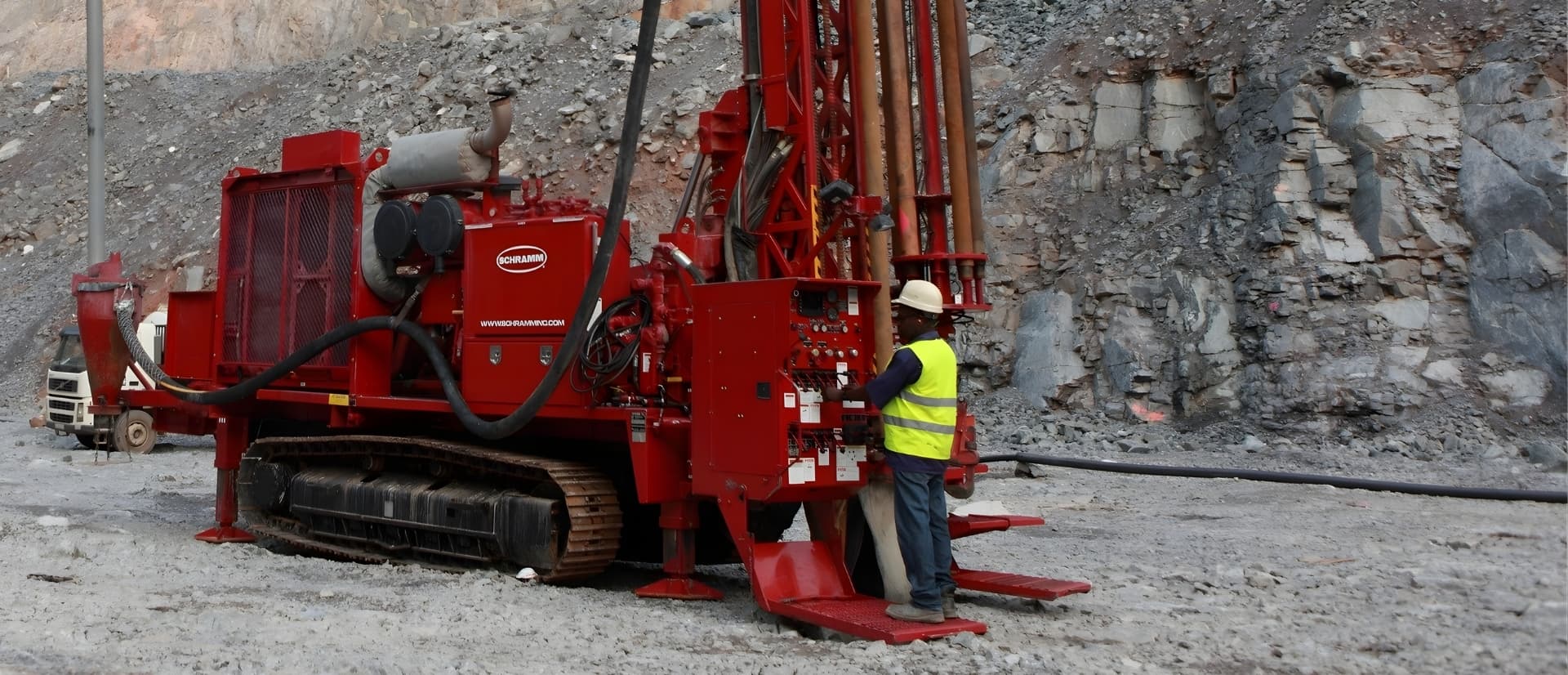
Reverse Circulation (RC) Drilling Rig Specifications
The figures below describe typical industry specifications for this class of equipment rather than a single fixed model. Use them to scope a requirement, then confirm exact figures against the supplied unit before purchase.
| Specification | Typical value |
|---|---|
| Typical depth capacity | 150–500 m |
| Hole diameter | 4.5–5.5 in (114–140 mm) |
| Sample recovery | Dry cuttings via cyclone and splitter |
| Penetration rate | 30–60 m per shift in typical conditions |
| Drill pipe | Dual-wall, 3–6 m rods |
| Compressor requirement | 900–1,150 cfm at 350–500 psi |
| Booster | Often required below ~200 m or in wet ground |
| Rig mounting | Truck, track or trailer |
| Sample splitting | Cone or riffle splitter, 1–3 kg per metre |
| Crew size | 3–5 per shift |
| Water requirement | Low. Dust suppression and wet-ground injection only |
| Best suited to | Resource definition, grade control, oxide and transitional ore |
What a Reverse Circulation (RC) Drilling Rig Is Used For
- Gold resource definition drilling
- Grade control on operating pits
- Regional target testing and first-pass drilling
- Water bore pre-collar drilling
Maintenance Schedule
Most premature failures in this equipment class trace back to a missed routine check rather than a design fault. The intervals below are a practical starting schedule; adjust them to your duty cycle and the manufacturer manual.
| Interval | Task |
|---|---|
| Every shift | Inspect hammer and bit for wear; check air pressure and cyclone seals; confirm splitter is clean between holes. |
| Daily | Grease rotation head and mast slides; check hydraulic oil level and hose condition. |
| Weekly | Inspect drill rod threads for galling; check compressor filters and coolers. |
| Monthly | Hydraulic oil sampling; mast structural inspection; wire rope and pull-down chain check. |
| Per contract | Third-party mechanical inspection and certification before mobilisation. |
Frequently Asked Questions
RC or diamond core drilling: which should I use?
RC is faster and roughly a third of the cost per metre, and gives ample sample for assay, so it suits resource definition and grade control. Diamond core gives an intact cylinder allowing oriented structural measurement, geotechnical logging and precise contact definition. Most programmes use RC for tonnage and core for structure and confirmation.
How deep can an RC rig drill?
Commonly 150–500 m. Depth is limited less by the rig than by air: as the hole deepens, the compressor must lift cuttings against a taller column, so a booster is usually needed beyond about 200 m, and beyond roughly 500 m sample quality degrades and core becomes the better option.
What compressor does an RC rig need?
Typically 900–1,150 cfm at 350–500 psi, often with a booster. Under-supplying air is the most common cause of poor sample recovery and stuck rods. The compressor specification is part of the drilling method, not an accessory.
Is RC sample quality good enough for a JORC resource?
Yes, RC is widely used for JORC and NI 43-101 compliant resources provided recovery is monitored, samples are split consistently, and QAQC protocols with standards, blanks and duplicates are followed. Wet samples and poor recovery zones must be flagged, as they carry real grade bias risk.
Supply and Delivery Across Tanzania
Bart Mining supplies reverse circulation (rc) drilling rig and related equipment to mining operations throughout Tanzania, with primary coverage of the Lake Victoria Goldfields (Mwanza, Kahama, Geita, Shinyanga and Bukombe), alongside the Lupa Goldfields around Chunya and Mbeya, and delivery nationwide from Dar es Salaam.
Request a quotation
Need a reverse circulation (rc) drilling rig specified for your site?
Tell us your duty, depth or throughput and available power supply. We will come back with a specification and price, and flag anything on site that needs to change to make it work.